
Home › Help and Advice › FAQs
FAQs
Here at A/C Pro®, we know you’ll have plenty of questions about your car air conditioning. We’ve gathered the most frequently asked questions in one place to give you all the knowledge you need about your car’s A/C. From the basics to using lubricants, leak sealers and compressor questions – find the answer to your query with these A/C FAQs.
A/C Compressor
How do I know if my compressor is working?
If the compressor is engaging, the center of the compressor clutch will turn with the outer pulley. If the pulley does not turn and there is a loud squeal, this usually indicates a locked up compressor. The compressor and drier will need to be replaced.
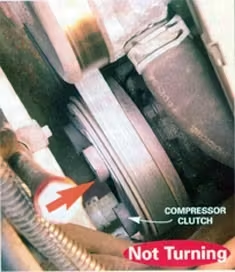
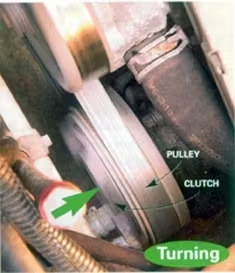
What if my compressor clutch is not engaging but the pulley is spinning freely?
If the vehicle’s refrigerant is low, the low pressure cut-out or low pressure cycling switch can prevent the clutch from engaging. Adding refrigerant should alleviate the problem.
How do I know if my compressor is on?
You can tell if you compressor is cycling on and off by looking at the clutch (or belt pulley) at the front of the compressor. The center of this clutch should be spinning when the compressor cycles on. Please note that the pulley itself will always spin while the center of the clutch may not.
What happens if my system is overcharged?
When you overcharge your system, a pressure cut off switch is activated to stop your A/C compressor from running. This in turn will cause your system to blow warm air. If this happens you will need to go to a car A/C professional and have the excess refrigerant recovered from your system. Remember it is illegal to vent refrigerant from your system, and the government can impose stiff fines for failure to follow these rules
Why do I need to prime a new compressor?
In order to prepare a new compressor for installation you will need to prime it. If you do not prime the compressor properly you could seriously damage it, and void the warranty on the product. Priming a compressor consists of adding oil to both the receiver dryer and the suction port of the compressor. Before starting you will need to know the oil capacity for your system and your compressor. You can check here to get the system specs for your specific vehicle.
Once you have determined the proper amount of lubricant for your particular compressor, pour half of the amount specified into the suction port of the compressor, and the other half of the specified amount into the receiver dryer.
Once you have installed the compressor back onto your car you will need rotate the compressor clutch 10-20 times to insure that the oil is properly distributed throughout the system and the compressor. To do this you will need a spanner wrench.
Do not turn the compressor nut in the middle of the pulley as this may affect the air clearance between the clutch pulley and the clutch face plate. After you have rotated the pulley 10 to 20 complete revolutions, the compressor will be properly primed.
Can I use A/C Pro® in my hybrid vehicle’s electric compressor?
No; if your car or truck has a fully electric compressor you can ONLY use straight refrigerant and ONLY approved hybrid vehicle lubricant. You cannot use any products that have additives that are not specifically formulated for use in hybrid vehicles. If you are unsure, we recommend checking with your vehicle manufacturer.
We do carry a hybrid-specific oil that can be used with straight R-134a gas, which you can find here. We still recommend you check with your vehicle’s manufacturer before using this product.
What color are the caps on the low pressure port and high pressure port?
Unfortunately, the caps on the high and low pressure automotive air conditioning service ports vary. In most cases, both caps will be black, but we have also seen them in grey, blue, and green. Sometimes they have an “H” or “L” to indicate High or Low pressure ports.
A/C Basics
How do I locate my low-pressure port?
To find where the low side ac service port is, look for the valve that is located on the line that runs from the compressor through the evaporator (firewall) and up to the condenser on the low pressure (suction) side of the system. R-134a Recharge hoses will only fit on the low side service port on all R-134a vehicles and R-12 vehicles that have been converted to R-134a. If you don’t know where your low side port is you can try using our low side port finder.
The only fitting that the standard recharge equipment will fit is the low side service port.
You can view images of typical low side port locations here.
What about so-called “drop in” refrigerant that I see advertised on the market?
The EPA requires that ANY replacement refrigerant MUST have unique fittings, charging devices and label. Therefore, the EPA states that “drop in” refrigerants are illegal. Furthermore, only R-134a has been tested and approved by the original equipment manufacturers.
Can I add R-134a directly to my R-12 system?
No. Federal law prohibits topping off an R-12 system with something other than R-12 refrigerant. Your options are to locate some R-12 refrigerant if you are certified to purchase, then add it with an R-12 recharge hose. Or you can convert the system using one of our R-134a retrofit kits that will allow you to now add 134a refrigerant to your automotive air conditioning system. You will have to make sure that you remove any residual R-12 refrigerant by having it evacuated prior to retrofitting your vehicle.
My A/C is blowing cold but not as cold as I would like it. Will adding additional refrigerant make the air colder?
The answer here is two-fold. It’s possible that the system has a small leak and is now low on refrigerant, which will allow the system to blow cold but now as cold as it used to. In this case, start by checking the system pressure via the low-side port. If it’s low, add refrigerant or a refrigerant with a stop leak to correct the system pressure. If the pressure is correct, adding additional refrigerant will not make the system blow out colder and will in fact cause the system to be overcharged. This will result in the system working less efficiently and warmer air will blow from the vents.
If I put in refrigerant (top off), do I need to add oil too? If so, what type and how much?
All A/C Pro® products contain the proper ratio of replacement oil.
How much refrigerant should I put in?
A pressure gauge must be used to determine the accurate system pressure and thus amount of fill. All A/C Pro® gauges indicate whether you should continue filling (recharging) or not.
Do I need to vacuum out my system before charging?
Your system should be vacuumed if you have replaced a component part in the system, or if the pressure gauge indicates that the A/C system pressure is lower than 10psi. If you do not know how to vacuum your AC system consult a professional.
I get two pressure readings while checking my low-side pressure, which one should I use?
When checking low-side pressure you will get two different pressure readings, one when the compressor cycles on and one when the compressor cycles off. Use the pressure reading when the compressor is cycled on and the system is operating at its highest settings (temperature to maximum cold and fan on high). When the compressor cycles on you should see the needle on your pressure gauge begin to drop. When the compressor turns off you will see the needle move back to a higher pressure. Take the reading that occurs when the pressure is at its lowest point when the compressor is cycled on.
What is Ambient Temperature and what should my pressure readings be?
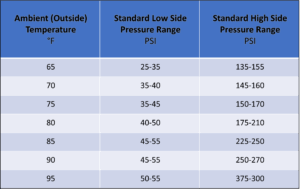
Ambient temperature is simply the temperature of the air surrounding the car. The following automotive A/C chart outlines the proper pressure readings for a particular temperature range. For instance, if the ambient temperature (outdoor temperature) is 75°, the corresponding low side pressure should be between 35-45 psi and if needed the corresponding high side pressure would be between 150-170 psi.
How do I recharge with T-Handle and Gauge-Handle style recharge hoses?
Follow these steps, and always remember to wear safety glasses and gloves when recharging your vehicle’s A/C:
- Determine the ambient (outside) temperature before starting to charge your car. If the ambient temperature is 55°F or below do not charge the car. To determine the proper pressure of your car’s A/C, set the bezel on the pressure gauge to the outside temperature and then read the corresponding pressure setting on the gauge. If your gauge does not have a bezel dial with the corresponding temperature and pressure, consult the pressure temperature chart. After determining the proper pressure for your AC system charge to that pressure.
- Locate the low side port. Important note: Only charge your A/C system through the low side service port. Never use the high side port to add refrigerant. Doing so is dangerous and could cause you harm. If you are having trouble locating your low side port, try using our low port location finder by clicking here. If you still cannot find your low side port, locate the large diameter aluminum line coming from the back of your car’s compressor. The low side port will be located somewhere along that line between the compressor and the firewall. Still can’t find the low side port? Give our technical help desk a call at 1-888-318-5454.
- Remove the sealing cap from the low side port and wipe any dust from the port with a clean rag. Attach the hose to the low side port. Tug gently on the hose to insure a snug connection. Note: The hose will only connect to the low side port fitting. If the hose does not easily attach you are trying to connect it to the wrong port.
- Turn the handle clockwise until it will not turn anymore. This extends the piercing needle into the top of the can.
- Turn the handle counterclockwise to start the product flowing. By turning the handle counterclockwise the piercing pin retracts from the top of the can allowing the product to escape. To check the pressure, close the valve by turning clockwise until it will not turn anymore. Remember turning the handle so that it travels up is “open” and turning it so that it travels down is “closed.”
- Keep the can in the upright position when dispensing product. Rotate the can between the 12 o’clock and 2 o’clock position when charging. It is important to stop every 30-45 seconds to take a pressure reading on the system to prevent overcharging the system.
- When the A/C is charged to the proper pressure, close the valve on the top of the can and remove the charging hose from the low side port. Replace the sealing cap on the low side port. Store any remaining refrigerant in a cool dry spot in your garage.
How to recharge with a trigger style AC recharge hose?
Follow these steps to recharge your car. Remember to always wear safety glasses and gloves when recharging your A/C.
- Determine the ambient (outside) temperature before starting to charge your car. If the ambient temperature is 55°F or below do not charge the car. To determine the proper pressure of your car’s A/C set the bezel on the pressure gauge to the outside temperature. If your gauge does not have a bezel dial with the corresponding temperature and pressure, consult this pressure temperature chart. After determining the proper pressure for your A/C system charge to that pressure.
- Locate the low side port. Important note: Only charge your A/C system through the low side service port. Never use the high side port to add refrigerant. Doing so is dangerous and could cause you harm. If you are having trouble locating your low side port, try using our low-pressure port locator. If you still cannot find your low side port, locate the large diameter aluminum line coming from the back of your car’s compressor. The low side port will be located somewhere along that line. Still can’t find the low side port? Give our technical help desk a call at 1-888-318-5454.
- Remove the sealing cap from the low side port and wipe any dust from the port with a clean rag. Attach the charging hose to the low side port. Tug gently on the hose to insure a snug connection. Note: The A/C recharge hose will only connect to the low side port fitting. If the hose does not easily attach you are trying to attach it to the wrong port.
- Squeeze the handle to start the product flowing.
- Keep the can in the upright position when dispensing product. Rotate the can between the 12 o’clock and 2 o’clock position while you are charging. It is important to stop every 30-45 seconds to take a pressure reading on the system to prevent overcharging the system.
- When the A/C is charged to the proper pressure remove the charging hose from the low side port and leave the trigger mechanism on top of the can. Replace the sealing cap on the low side port. Store any remaining refrigerant in a cool, dry spot in your garage.
Is an overcharged system dangerous?
Not only is overcharging your system potentially dangerous, but an overcharged system will also not function properly and can seriously damage your A/C compressor or other component parts. The symptoms of an overcharged A/C system are the same as a system that is undercharged: Warm air out of the vents.
To prevent overcharging your A/C system it is imperative to measure the pressure before beginning to charge it. To measure the pressure in the A/C system, attach a pressure gauge to the low side port. Your car must be running with the A/C system set to maximum cool and the fan in its highest setting. It is important to note that the proper pressure in your A/C system is dependent on the ambient (outside) temperature. To determine the proper pressure for your system, consult a pressure chart such as this one, or set the bezel arrow on your pressure gauge to the corresponding ambient temperature and charge to the pressure corresponding to that temperature setting. If the outside temperature is at or below 55°F do not charge your car. Also, never charge your vehicle above 55 PSI.
What color are the caps on the low-pressure port and high pressure ports?
Unfortunately, the caps on the high- and low-pressure automotive air conditioning service ports vary. In most cases, both caps will be black, but we have also seen them in gray, blue, and green. Sometimes they have an “H” or “L” to indicate high- or low-pressure ports.
Wondering where your car or truck’s low-pressure port is located? Use our Port Locator.
Does refrigerant go bad?
No. Your car’s A/C refrigerant never goes bad. Nor do you “use up” the refrigerant that is in your system. If your vehicle’s A/C system pressure is low, your vehicle has a refrigerant leak and that leak will need to be repaired in order for your system to hold refrigerant. If your vehicle is able to maintain a charge for a period of two weeks or longer, then it is possible to seal the leak with sealant such as Super Seal. If your system will not hold a charge for at least a two week period then it is advisable to seek professional assistance to find and repair the leak.
What should my vent temperature be?
Vent temperature will vary. Some newer cars may have vent temperatures that are below 50°F while older model cars’ vent temperatures may be in the mid-50’s to low 60’s.
Will using the new recharging system take longer?
No. The time it takes to recharge your A/C system, and the ease of use, are virtually the same as the existing system.
Can I recharge my A/C system myself?
Yes! This is one of the easiest jobs that you can do yourself on your vehicle. Please click through the following FAQs to learn how you recharge your AC using our products:
Please feel free to call our technical support line for further help at 888-318-5454.
Can I use your products in my hybrid vehicle?
If the vehicle has a fully electric compressor (no belt-driven pulley) then you can use some of our products which have been developed specifically for hybrid and electric vehicles. As a rule of thumb, on hybrid vehicles you should ONLY use hybrid lubricant and straight refrigerant, however A/C Pro® has your back. Refer to our individual product pages for more information and to find what specific products can be used on your vehicle.
Can I add refrigerant to my vehicle when it is cold outside?
To properly charge you automotive A/C system the ambient temperature should be above 65ºF. Anything below that does not allow the system to build up enough pressure for a proper reading on your A/C Pro® pressure gauge. Because of this, adding refrigerant to your vehicle is not recommended when the ambient temperature is under 65ºF.
If I use a universal gauge on a piercing valve can, can I remove the gauge before I’ve used the entire can without leaking the remaining refrigerant into the atmosphere?
No. While our new universal gauges work with both types of valve systems, they do not make a piercing valve act like a self-sealing valve. If you are using a piercing can, you will want to keep your gauge attached to the can until it is depleted.
My pressures are correct but I am still getting warm air from the vents. Why?
There are several possibilities. Your compressor may be damaged and not working properly. You can check to see if it is cycling on off properly by looking at the clutch plate face in the middle of the compressor pulley.
If your compressor is not cycling on, then you should seek the help of an A/C professional immediately. Ignoring the problem will not make it go away and in fact it could make matters worse. Other possible causes are blown relays and fuses, defective sensors, or a stuck blender door. Seek the help of an A/C professional to assist you in determining the cause in your case.
How do I use an R-134a charging hose to add/recharge R-134a refrigerant to my system?
To proper use a 134a recharge hose simply follow these instructions:
- Turn the valve handle of the charging kit counter clockwise until the piercing stem is in the up position. This will prevent accidentally piercing the can. Screw the charging kit onto the can.
- Attach the quick connect fitting to the low side service port.
- Start engine and put A/C settings on maximum cool with the fan settings on high.
- Turn the valve handle clockwise until the piercing stem has punctured the can.
- Turn the valve counter clockwise until you feel the refrigerant leaving the can. See packaging for complete details. Always wear protective gloves and eyewear.
Can I just vent the refrigerant if it is overcharged?
No. Not only is it harmful to the environment to vent refrigerant into the atmosphere, it is also illegal. Violation of this Federal Law may carry a fine of up to $25,000. If you need to recover refrigerant from your system please seek the help of a qualified service technician.
Why is there a smiley face on the bottom of some of your cans?
The smiley face on the bottom of the can is a pressure relief vent to help release the pressure of the can should it become overheated. The refrigerant in the can is a high-pressure gas. As with any gas it expands when heated. Therefore, you should never leave or store any cans of refrigerant in your car compartment as they could overheat and rupture the can. You should always store the cans in a cool, dry spot in your house.
Why does the blue bezel on some of your gauges turn?
The blue bezel turns on the gauge so that you can set the pressure range as it relates to the outside temperature. Here is how it works: determine the outside temperature around your car. Turn the bezel so that the arrow points to the outside temperature. Notice the “V” shape on the dial.
This is the appropriate pressure range based on the ambient (outside) temperature. When reading the pressure, if the arrow is below the range then charge the car until the needle on the pressure gauge is in the range. If it is above the upper end of the range your system is overcharged. In this case you should seek the help of a qualified technician to recover refrigerant from your system to bring the system back into the proper range. Never vent A/C refrigerant into the atmosphere. It is harmful to the environment and illegal to do so.
There are no expiration dates on your products. Should I be concerned that the refrigerant in a piercing valve can is too old to work correctly?
R-134a refrigerant and the additives that accompany our products do no expire or “god bad”. You can purchase an older generation can with confidence that its contents are just as capable as a newly packaged product.
Why does my gauge go into the red/high pressure?
The most common reasons the pressure gauge indicates a red/high pressure reading are either that the car is not running or the A/C is not on with the fan set to its highest setting and the A/C temperature set to its coldest setting. To obtain an accurate pressure reading, the car must be running with the A/C set to its coldest and the fan set to its highest. Also, as the car’s compressor cycles on and off, the needle on the gauge may move in and out of the red/high pressure area of the gauge. This is normal.
A/C Leak Sealers
How do I know if I might have a leak?
If your vehicle’s A/C isn’t blowing cold it is likely low on refrigerant due to a leak. Most leaks are in rubber components such as O-rings, hoses, and gaskets.
How do I find a leak?
The best way to find leaks is with our R-134a UV Leak Detection Kit (part # 436) which provides UV dye, high-intensity UV light and yellow tinted protective glasses.
Is it safe to keep dye in the system?
Yes. The dye will not affect A/C performance.
With dye remaining in the system, will the dye show any future leaks?
Yes, the dye will continue to work the same way.
How fast will leak sealer work?
The leak sealer will take effect within 1 day of installation.
How long will leak sealers keep leaks sealed?
It of course depends on the nature of the leak, but typically leaks are sealed for approx 12 months of A/C usage.
Will leak sealers seal ANY leak? What size hole will they seal?
They seal small holes that leak less than one can per month.
Are leak sealers safe for my A/C system? What does “System Safe” leak sealer mean?
Yes. IDQ “System Safe” leak sealer is a gentle o-ring conditioner that does not destroy o-rings.
How do I know if the leak sealer is working?
Your system will leak less refrigerant than it did previously. You cannot find a leak with the UV light that was there previously. Your system continues to blow cold air.
What if I use a leak sealer and recharge my system, but it’s still not blowing cold?
You should seek professional help.
Diagrams / Specs
Typical Automotive A/C System
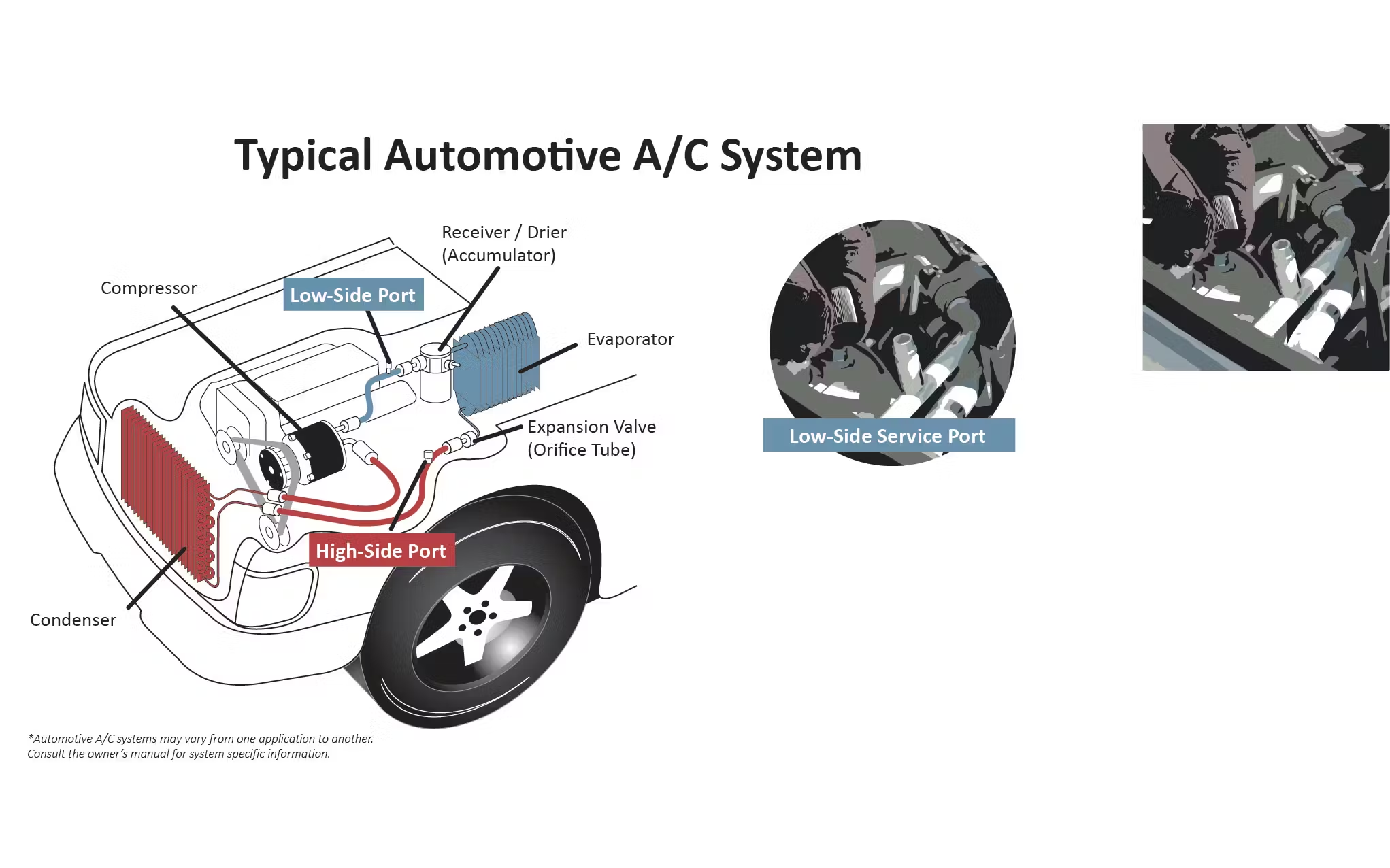
Chart of refrigerant specifications by vehicle make
Please click here to view the specifications by vehicle make.
R-134a System Pressure Charts

How do I locate my low pressure port?
Need help finding your low side port? Use our Low Pressure Port Finder.
Lubricants
Why are there different types and viscosities of oil, and which should I use?
For retrofitting and top-offs, use products that include Polyol Ester oil. When rebuilding a system that has been opened and flushed, use a pourable PAG oil of the viscosity that is recommended by the compressor manufacturer.
If I put in refrigerant (top off), do I need to add oil too? If so, what type and how much?
When an A/C system leaks refrigerant, some oil escapes also. Our products all have the proper ratio of oil to refrigerant already blended to replace the lost oil.
What kind of oil should I use for retrofitting?
Please click here to view the R-134a oil specifications by vehicle make.
What type of lubricant does a hybrid system use?
Special electrically insulating refrigerant oil is used to keep voltage from leaking to the compressor case through the oil. According to the hybrid manufacturers if even a small amount of another oil is introduced into the system, it may significantly decrease the electrical insulation properties causing compressor damage. The introduction of the wrong oil can cause a diagnostic trouble code that disables the air conditioning system.
Hybrid vehicle makers also warn that if the wrong oil is introduced into, and circulated through the system, all of the main A/C parts (such as the evaporator, condenser, receiver/drier, and compressor) must be replaced. They recommend a dedicated manifold gauge set be used when charging the system to ensure that any residual refrigerant oil left in the manifold gauges from refrigerant recovery on other vehicles does not enter the air conditioning system and deteriorate the insulating performance of the special oil. Our HYB-1 and HYB-2 meet the OEM criteria for hybrid A/C lubricants.
Super Seal Leak Sealer
How long will a repair using A/C Pro® Super Seal last?
Any leak fixed by A/C Pro® Super Seal during a recharge creates a permanent bond that should not leak from that point again. In addition, A/C Pro® Super Seal will continue to flow through the air conditioning system as a lubricant and seal any new leaks that may develop, making it great for preventative maintenance.
Can I use two cans of Super Seal on my vehicle?
One can of Super Seal is all you need to seal pin hole sized leaks in your system. In order to determine the size of your leak use the following rule of thumb: your car must be able to hold a refrigerant charge for at least two weeks. If you car can hold a charge for two weeks before blowing warm again, then Super Seal will be able to patch your leak. If you have a large hole or leak using two cans of Super Seal will not help.
Has the chemical technology in Super Seal ever been used before?
Yes. The sealant technology in Super Seal has been used for decades in the underground gas transfer industry, sealing leaks in pipes, tanks, compressors, and other gas filled containers.
Will Super Seal clog any component of my AC system?
No. The chemical formulation remains in a liquid state inside the a/c system until it detects moisture at the leak point and self-seals. Super Seal contains a drying agent to prevent any sealing activity while in the system. Super Seal will be removed from the system with the refrigerant as it either leaks out or is removed.(See installation instructions.)
What happens to the Super Seal if all the refrigerant leaks out and air enters my AC system?
Super Seal has a lower boiling point than the refrigerant oil. This enables the Super Seal to be removed from the system as the refrigerant either leaks out or is removed.
What size hole will Super Seal repair?
Super Seal will repair most leaks. However, if the system cannot hold a charge for 24 hours, the leak is too large and probably needs manual repair. If the system is leaking slowly and holds a charge for more than two weeks, Super Seal should seal the leak. Super Seal will seal multiple holes in both the metal and rubber parts of the air conditioning system. Super Seal is an inexpensive alternative considering a repair that could be in $1000 range.
How do I know Super Seal works?
Super Seal has sealed leaks in over 1,000,000 vehicles since its introduction in early 2000. This moisture activated sealant technology has long been used in the gas transfer industry, sealing leaks in pipes, tanks, and other gas filled containers.
How does Super Seal work?
While in the air conditioning system, it remains a liquid lubricant and contains additives to penetrate and rejuvenate o-rings, gaskets and other rubber connectors to prevent leakage. Included in Super Seal is a drying agent that gets rid of any moisture that may be inside the air conditioner. If the refrigerant leak occurs in a metal part, the refrigerant leaves the system and chills the outside air causing condensation. This moisture activates the Super Seal fluid to form a scab on the exterior of the metal.